

Tip #10 (02/03/2026) – Kiddle
Kiddle is an online search engine created for young learners. The website claims that it filters off inappropriate content through Google Safe Search and the first three pages of each search are selected as kid appropriate by kiddle moderators (the rest of the results vary from kid-friendly to more complex content).
One prominent Kiddle feature is the Kpedia section under the name of “Facts”, where around 70,000 Wikipedia pages on subjects varying from “Science” to “Language and Literature” have been adapted for a younger audience and may be used as research source for “school homework help, homeschooling and general education” (Kiddle).

Researchers PILGRIM, VASINDA and LISENBEE (2019, p.16) highlight that the
“Internet use in the home, workplace, and across all disciplines, requires a set of skills to navigate information, sort commentary from news, determine content from advertisements, identify biases and opinions, and discern source validity and reliability. These skills are required for research at every level, and therefore, must be addressed and taught to children”.
Besides that, kids tend to respond better to certain visual patterns, such as bolder colors, bigger images in thumbnails, shorter and more direct sentences (Gossen, Hobel, Nurnberger, 2014). Hence, in order to introduce or help young learners to navigate the digital world, it is important for a teacher to find tools that may be able to provide a safer approach to Internet Search Engines.
According to Kiddle, in order to adapt to a K-12 age range, the search engine recurs to bigger visual cues, larger fonts and privacy measures such as restricting social media networks and not sharing personal data.
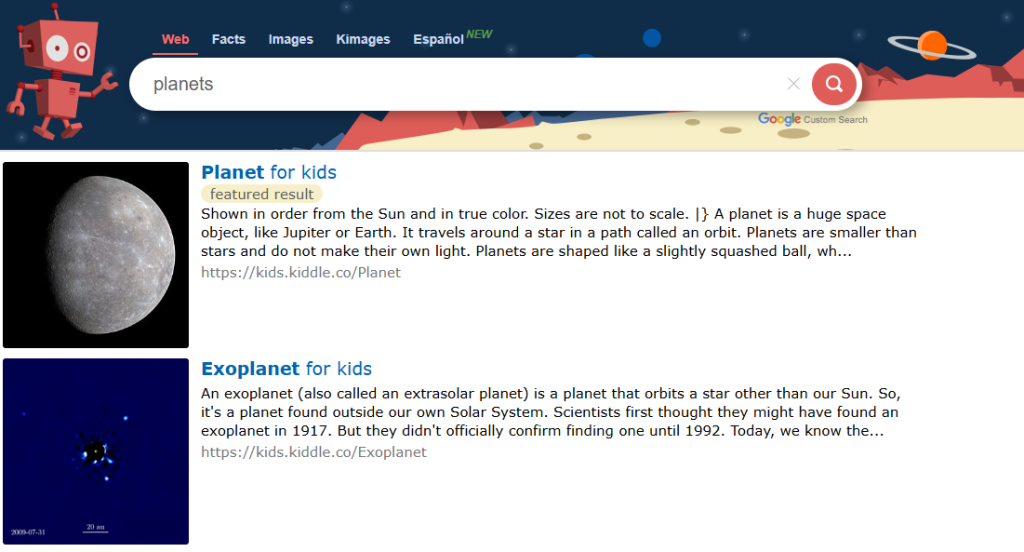
Finally, it is important to consider that Kiddle.co and other search engine for children “do not include the same affordances for learners as universal search engines” (PILGRIM, VASINDA and LISENBEE, 2019, p.41), consequently, the platform does not necessarily replace traditional search engines, but we consider that it may serve as an interest starting point for young student’s firsts steps in exploring the Web.
Kiddle can be a useful tool to help young learners with their digital literacy skills by providing a safe space for exploration on topical subjects. Classroom uses could vary from teaching children how to use basic features of search engines to applying critical thinking skills in order to fact check information and its sources.
Pros (Pierce, 2025):
- Safe search results: Kiddle filters search results to exclude explicit or mature content.
- Child-friendly interface: Kiddle’s homepage has brightly colored graphics and a simple interface, which is easy to use and attractive for kids.
- Easy parent control: For parents who opt to use Kiddle, there is a “contact us” button for reporting inappropriate search results or feedback, to which the Kiddle team responds quickly.
Cons (Pierce, 2025):
- Not tailored to individual users: Kiddle’s search results are often generic, which isn’t relevant to children who may be searching for something specific. It does not always display information adjusted by location or region relevance.
- Limited scope: Kiddle is often limited in what it suggests to children to explore. Sometimes, children may want to dig deeper or do more in-depth searches, which isn’t possible with Kiddle.
Additional Resources:
Lesson plan: “Finding the Source: Where does online information come from?”
REFERENCE
GOSSEN, Tatiana; HÖBEL, Juliane; NÜRNBERGER, Andreas. 2014. CHI ’14. A comparative study about children’s and adults’ perception of targeted web search engines.
Kiddle.co: Kids encyclopedia facts.PIERCE, Rebekah, 2025. Findmykids Blog. Kiddle for Kids: A Fun and Safe Search Engine.
PILGRIM, Jodi; VASINDA, Sheri; LISENBEE, Peggy, 2019. Journal of Literacy and Technology Universal design for learning: Examining access afforded by children’s search engines.
SIGUE, Marinel. Slashgear, October 2024. WHAT IS THE KIDDLE SEARCH ENGINE AND IS IT OWNED BY GOOGLE?
