

Tip #12 (30/10/2026) – Busuu
AI tools are increasingly present in the lives of both teachers and students. Using these tools critically is an effective way of rethinking educational environments. As stated by Kharbach (2026), it does not replace the teacher; rather, it extends teachers’ capacity by serving as a partner capable of optimizing the planning time and opening new opportunities for education (Kharbach, 2026).
Before implementing AI in English language teaching, it is important to understand the different types of AI tools available. In his guide to AI literacy for teachers, Kharbach (2026) identifies four categories of AI in education:
Generative AI, which creates text or images (e.g. ChatGPT, Gemini, Claude, Copilot);
Recommendation Systems, which suggest content based on usage (e.g. YouTube and Learning Apps);
Speech Recognition, which converts speech to text (e.g. Speechify and Otter);
and finally, Automated Feedback tools (e.g. Grammarly, DeepL Write, and Quillbot)

Adapted from Kharbach (2026).
In this Tech Tip, we suggest Busuu.
Busuu is an app and a website that provides interactive foreign language learning across activities, with reading, speaking, listening and writing practice. The platform uses tools such as Generative AI, Speech Recognition and Automated Feedback to enhance language practice with conversation simulations, pronunciation checking and feedback.
Examples of Busuu’s tools:
- “AI conversations” enables learners to practice listening and speaking by speaking with Busuu’s AI. After the conversation, Busuu evaluates the speaking and provides some feedback about what was said;
- “Speaking Practice” allows learners to practice speaking by repeating what the AI host says;
- “Community” is a tab for learners to share their questions and ask for evaluation of real people. The user is able to ask for feedback and comment on other people in writing or speaking.
- “Courses”. Besides the standard language course, Busuu’s also provides courses focusing on specific subjects such as “English for Travel”, “Life in the US”, “The World in English” and others.
Some of these features use AI. Jovanovska (2025) commented about the possibilities of using AI features in language teaching, including Busuu’s methods:
“These technological solutions enable personalized and customized learning individual needs and learning styles, interactive exercises that encourage engagement and motivation, automated assessment of progress and quick and precise feedback” (Jovanovska, 2025).
Busuu’s website claims that their activities are developed using the Common European Framework of Reference (CEFR); it provides modules from Beginner (A1) to Advanced (C1) levels (Busuu, 2026).
Busuu operates with two versions: the standard free one provides resources for language practice, but others require a premium subscription.
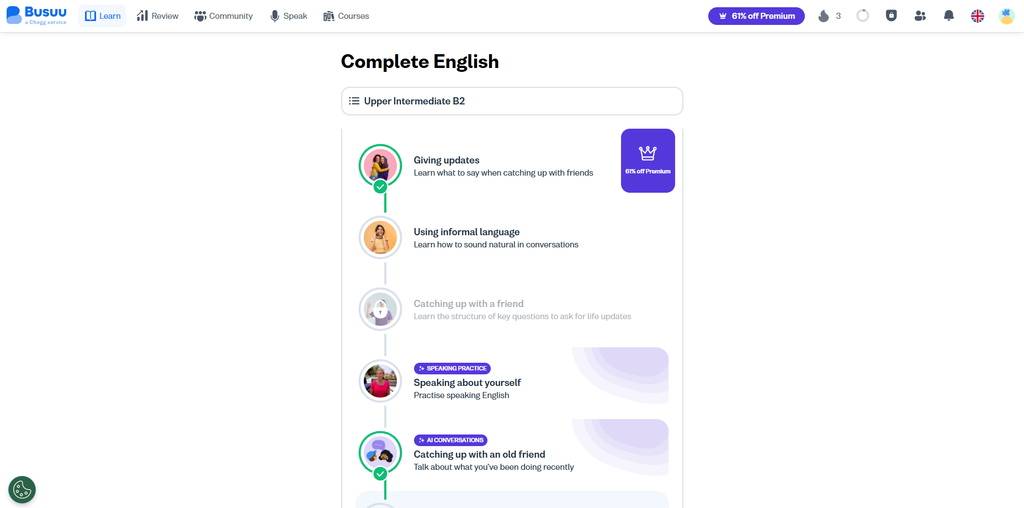
Busuu’s website interface (Busuu, 2026)
Mulyadi & Maesaroh (2021) research shows that using Busuu as a teaching medium improves students’ speaking performance.
The results showed that there were significant differences in students who were taught using the Busuu application as a media. The average score of the students’ pre-test was 61,875. Then in the post test, the average score for the class is 73,750. In other words, the use of Busuu application media is used in teaching speaking to effective class X students (Mulyadi & Maesaroh, 2021).
These authors add that this tool offers:
- Progress monitoring
- AI speech recognition for pronunciation practice
- Automated assessment & real-time feedback
- Low-anxiety environment
- Student autonomy
- Measurable Improvement in Speaking and Core Language Skills
Considering these possibilities, teachers can integrate Busuu’s and its AI-driven features into their lesson plans, using the app for interactive classroom activities, homework assignments and for diagnostic assessment, working with Busuu in groups or individually.
Here are some examples of using Busuu in classroom:
1. Self-introduction activity (speaking practice):
Teachers assign Busuu’s “Introductions, Greetings and All about me” chapters (A1 level module) for students to complete them at home and bring what they learned in a sharing moment to speak confidently about themselves during the class.
In this activity, AI-powered tools such as speech recognition and “AI conversations” serves to practice students’ pronunciation and compare their speech to recordings of Busuu’s speakers, receiving automated feedback from the app, improving their self-introduction skills in preparation for class and practicing in a low-anxiety environment.
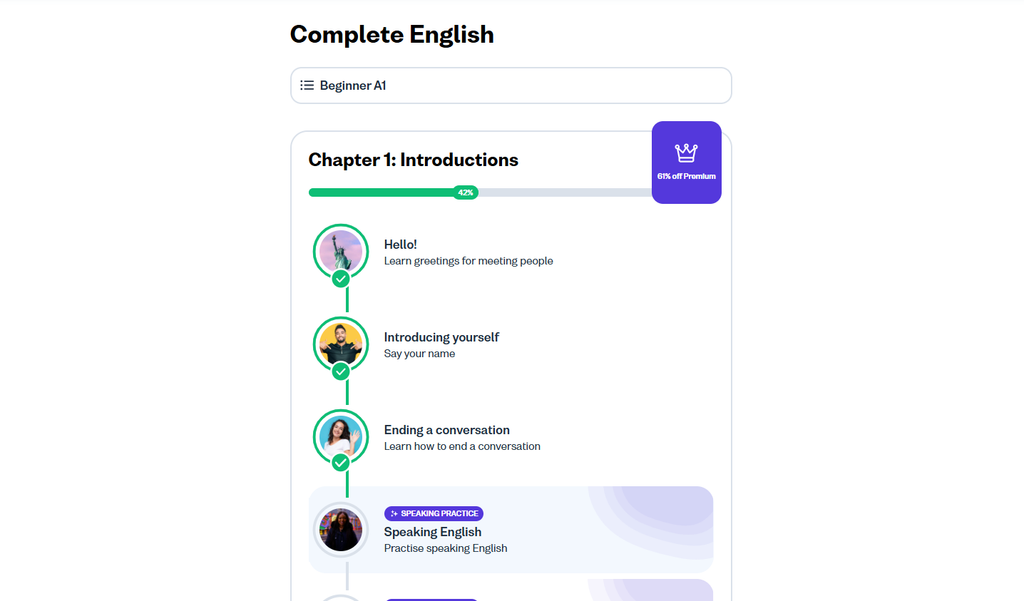
Busuu’s A1 chapters (Busuu, 2026)
2. Real-time evaluation:
In the school’s tech lab or using students’ smartphones, separate the class in groups or pairs and ask them to complete interactive exercises of listening and repetition tied to topics that the teacher covered in the class as a strategy for evaluation of students. Busuu’s automated feedback evaluates students’ performance in real time with instant scoring, allowing teachers to track group progress and assess learning dynamically.
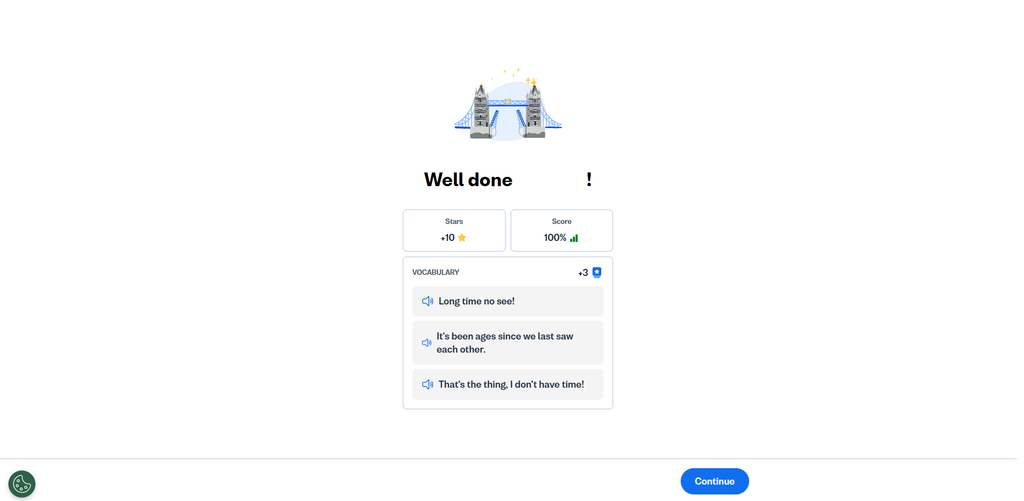
Busuu’s feedback activity (Busuu, 2026)

Another example of activities on Busuu. Busuu’s A2 modules (Busuu, 2026)
3. Shadowing and accent analysis:
Busuu lessons include activities with audiovisual resources of real people from different parts of the world speaking the language. It is called “Speaking Practice”:
“Speaking practice is a series of “listen and repeat” exercises – which involves repeating aloud what you hear, word for word, with as little delay as possible – inspired by Alexander Arguelles’ shadowing technique” (Busuu, 2026). Teachers can present English language accents to the class, exploring the idea of English as Lingua Franca (EFL). This way, listening and reproducing alongside the app’s speakers, help students to refine their pronunciation, rhythm and understanding of the language.

Busuu’s Speaking Practice (Busuu, 2026)

Another example: Busuu’s Improve Pronunciation Tab (Busuu, 2026)
4. Grammar and vocabulary review:
After completing some modules in the app, Busuu enables the user to get a review in both grammar and vocabulary on the “Review” tab. The app reviews it in a personalized way based on the exercises completed:
It’s easy to see which topics you do and don’t need to focus on thanks to a progress chart neatly categorised into ‘Needs practice’, ‘Improving’, ‘Strong’ and ‘Mastered’. This chart automatically updates, powered by AI, based on when you last practised, what you’ve learned and how you scored (Busuu, 2023).
Once the learner completes one module, the review tool is unlocked. Thus, it may be used as an alternative to review some topics with the class
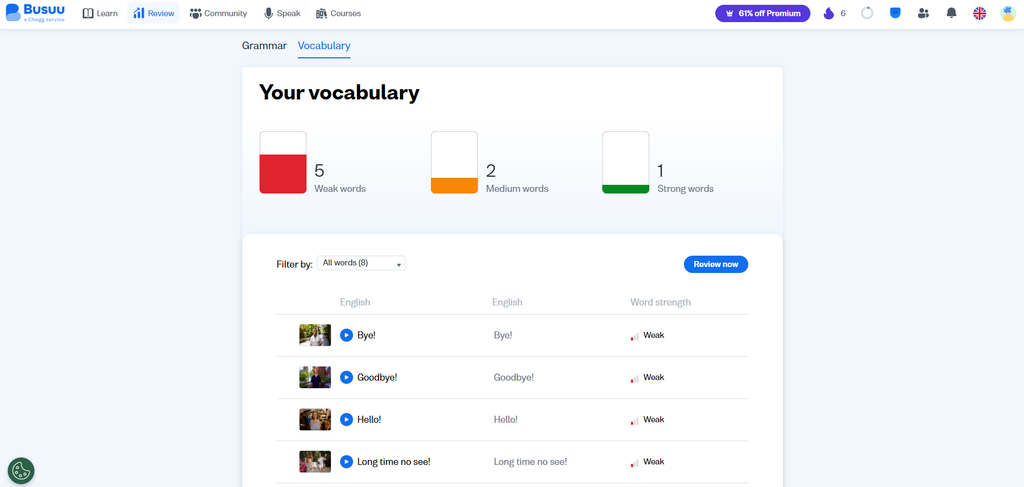
Busuu’s Review Tab (Busuu, 2026)
5. Giving and receiving feedback:
Students are allowed to explore the “Community” tab on the website and listen to real people’s audio and text and add their own speaking and writing productions.
The teacher may ask them to use this resource to practice four skills (speaking, listening, reading and writing). Another possibility is creating a community of the classroom on the app and letting students use the tab “Friends” to evaluate each other.

Busuu’s Community Tab (Busuu, 2026)
All these activities can be adapted to the classes’ situation. Teachers may use a projector to show it to the class or ask students to use it individually or in groups, exploring the free version of the app following teachers’ instructions and observations. Furthermore, the teacher may create other lessons using the app.
Busuu has its own blog. Access it here.
In conclusion, we must bear in mind that Busuu does not substitute the teachers’ English classes. It is an optional partner that helps develop a dynamic language learning process.
REFERENCES:
BUSUU. How our language courses work. Busuu, 2026.
BUSUU. Mastering language skills through speaking practice. Busuu Support, 2025.
MULYADI, Ade; MAESAROH, Mesa. The effectiveness of using “Busuu” in teaching speaking. Jurnal Fakultas Keguruan & Ilmu Pendidikan, out. 2021.
JOVANOVSKA, Sashka. Application of Artificial Intelligence in Foreign Language Learning. Journal of Applied Languages and Linguistics, 2025.
KHARBACH, Med. AI Literacy Simply Explained for Teachers [without date] .
